
Chandra Explains Why Black Hole Growth Slowed Since Cosmic Noon

Zhibo Yu
We welcome Zhibo Yu as our guest blogger. He is the first author of a paper that is the subject of our latest Chandra press release and is a fourth-year PhD student in the Department of Astronomy and Astrophysics at Penn State University, where he works with Prof. Niel Brandt on surveys of active galactic nuclei. His research primarily focuses on the coevolution of supermassive black holes and their host galaxies. Zhibo joined Penn State in 2022. Before that, he earned his B.S. degree in physics from Fudan University, China, where he worked with Prof. Cosimo Bambi on black-hole X-ray binaries
In the late 1950s, astronomers began to discover powerful radio sources in the sky with very small angular sizes in visible light. These strange “star-like” objects were later known as “quasi-stellar objects” (QSOs), or quasars, which are very far away from our own Galaxy and are extremely luminous. Afterwards, in the early 1970s, Dutch-born American astronomer Maarten Schmidt was among the first to find that quasars appear to be more abundant when they are farther away from us.
Today, astronomers believe that these luminous quasars are powered by actively growing supermassive black holes (SMBHs) in the centers of galaxies. Many growing SMBHs are not as bright as quasars and are generally referred to as active galactic nuclei (AGNs). When astronomers observe distant growing SMBHs, they are also looking back in time because light takes time to travel from these black holes to us. The farther away a black hole is, the earlier in cosmic history we are seeing it.
Spring Collection: Spring Has Sprung in Space (As Always)
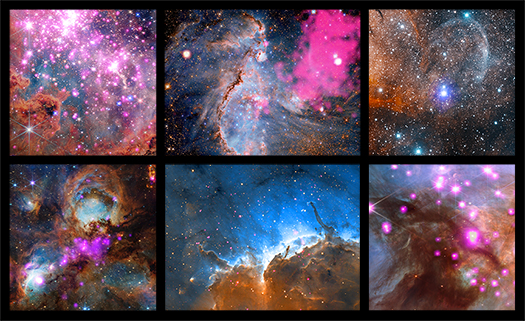
In the Northern Hemisphere this week, the calendar officially passes from winter into spring when the length of the day and the night become equal as the days become longer. Meanwhile, there are places in space where blooms of the stellar variety are always growing.
This collection of images from NASA’s Chandra X-ray Observatory and other telescopes contains regions where stars are forming. Often nicknamed “stellar nurseries,” they are cosmic gardens from which stars – not plants – emerge from the interstellar soil of gas and dust. X-rays are energetic enough that they can penetrate the gas and dust of these stellar nurseries, giving insight to the young stars and other high-energy phenomena that are happening within, including the effects of X-rays on any planets or planet-forming disks orbiting stars.
NASA's IXPE and Chandra Take a New Look at an Old Supernova

RCW 86
More images and information
Credit: X-ray: Chandra: NASA/CXC/SAO, XMM: ESA/XMM-NEWTON, IXPE:NASA/MSFC; Optical: NSF/NOIRLab;
Image Processing: NASA/CXC/SAO/J. Schmidt
NASA’s Imaging X-ray Polarimetry Explorer (IXPE) has taken a new observation of what may be the first documented evidence of a supernova, RCW 86.
RCW 86 is approximately 8,000 light-years from Earth in the Southern constellation of Circinus, occupying a region of the sky slightly larger than the full moon. In the year 185 AD, Chinese astronomers recorded witnessing a “guest star” in this area of the night sky that remained visible for 8 months.
How the Most Energetic Explosions in the Universe Are Formed

Simone Dichiara
We welcome Simone Dichiara as a guest blogger. Simone is the first author of a paper that is the subject of our latest press release. He is an Assistant Research Professor at Penn State University and currently works at the Mission Operations Center of the Neil Gehrels Swift Observatory, where he serves as an Observational Duty Scientist and as Instrument Scientist for the X-Ray Telescope (XRT) onboard. Since the early years of his master’s degree, Simone has focused his research on a particular class of astrophysical transient sources known as Gamma-Ray Bursts (GRBs), which are among the most energetic explosions in the Universe. His research continued during his Ph.D. at the University of Ferrara, under the supervision of Cristiano Guidorzi and Lorenzo Amati, and throughout his postdoctoral appointments at the National Autonomous University of Mexico and at NASA Goddard Space Flight Center. He has extensive experience in observational time-domain astronomy and has been directly involved in observational campaigns using several ground- and space-based observatories operating across a broad range of wavelengths, from the optical band to very high-energy gamma rays. He has served as Principal Investigator (PI) or Co-Investigator (Co-I) on multiple approved observing programs with the Chandra X-ray Observatory.
Neutron stars are among the most extreme objects known in astrophysics. These compact stars are formed in the explosive deaths of massive stars and compress down to become between 1.4 and 2 times the mass of the Sun into a sphere only tens of kilometers across (roughly the size of a city). Their density is so high that a single teaspoon of neutron star material would weigh billions of tons.
When two of these cosmic monsters orbit each other and eventually collide, they produce extremely powerful bursts of radiation called "gamma-ray bursts," (GRBs) which are among the most luminous electromagnetic events in the Universe. These brief flashes of extremely energetic gamma-ray radiation can momentarily outshine all other sources in the sky detected by gamma ray space-based observatories. Although they last from only a fraction of a second to a few minutes, during that time they can release as much energy as the Sun will emit over its entire lifetime.
Listen to This Month's "Planet Parade" with NASA's Chandra

The Planets Jupiter, Uranus, and Saturn
More images, videos, and information
Sonification Credit: NASA/CXC/SAO/K.Arcand, SYSTEM Sounds (M. Russo, A. Santaguida)
In late February, people in the Northern Hemisphere can look up for a special sight: Six planets will all be visible from clear and dark night skies. New sonifications from NASA’s Chandra X-ray Observatory released Wednesday will help commemorate this latest “planetary parade.”
Because the planets in our solar system travel around the Sun in the same plane (known as the ecliptic), they will sometimes appear bunched together in the sky when their orbits find them on the same side of the Sun at the same time. When this happens, it looks like the planets have roughly formed a line from our vantage point on Earth.
In Chandra’s sonifications, which translate astronomical data into sound, three of the planets that will be on display — Jupiter, Saturn, and Uranus — can be seen and heard in ways that they cannot from Earth.
Young "Sun" Caught Blowing Bubbles by NASA's Chandra

HD 61005
More images, videos, and information
Credit: X-ray: NASA/CXC/John Hopkins Univ./C.M. Lisse et al.; Infrared: NASA/ESA/STIS; Optical: NSF/NoirLab/CTIO/DECaPS2;
Image Processing: NASA/CXC/SAO/N. Wolk
This image contains the first astrosphere, or wind-blown bubble, that astronomers have captured surrounding a star that is a younger version of our Sun. This discovery was made using NASA’s Chandra X-ray Observatory and is described in our latest press release.
The astrosphere was found around a star called HD 61005, which is located only about 120 light-years from Earth. HD 61005 has roughly the same mass and temperature as the Sun but is much younger with an age of about 100 million years, compared to the Sun’s age of about 5 billion years. This commonality with the Sun is important because the Sun has a similar bubble, which scientists call the heliosphere. The discovery of the astrosphere around HD 61005 gives astronomers a chance to study a structure that may be similar to what the Sun was embedded in several billion years ago.
A Cosmic Heart Where New Stars Thrive

Cocoon Nebula
More images and information
Credit: X-ray: NASA/CXC/SAO; Infrared: NASA/JPL/Caltech(WISE); Optical: M. Adler, B. Wilson;
Image Processing: NASA/CXC/SAO/L. Frattare
To celebrate Valentine's Day, we are releasing a new image of the Cocoon Nebula (officially named IC 5146). This heart-shaped nebula is a region in the Milky Way galaxy where new stars are forming. X-ray data from NASA’s Chandra X-ray Observatory (red, green, and blue) reveal a cluster of new stars that are just poking through the stunning nebula. Young stars, like those in the Cocoon Nebula, are very active and give off large amounts of X-rays that Chandra can detect.
Celebrate the 'AstrOlympics' During the Winter Games in Italy

The ‘AstrOlympics’ project connects the amazing physical feats of the athletes competing in the Olympic Games to the spectacular physical phenomena discovered by NASA and other telescopes in space.
By comparing examples of speed, acceleration, time, mass, rotation, density, and more of athletes on the ground to objects in space, viewers of AstrOlympics may find new appreciation and inspiration from both.
The AstrOlympics project, which runs for both the Summer and Winter Games, has been celebrating cosmic and athletic triumphs since 2016. It was conceived of and developed by the science center for NASA’s Chandra X-ray Observatory, which is operated by the Smithsonian Astrophysical Observatory on behalf of NASA.
NASA Telescopes Spot Surprisingly Mature Cluster in Early Universe
Protocluster JADES-ID1
More images, videos, and information
Credit: X-ray: NASA/CXC/CfA/Á Bogdán; Infrared (JWST): NASA/ESA/CSA/STScI;
Image Processing: NASA/CXC/SAO/P. Edmonds and L. Frattare
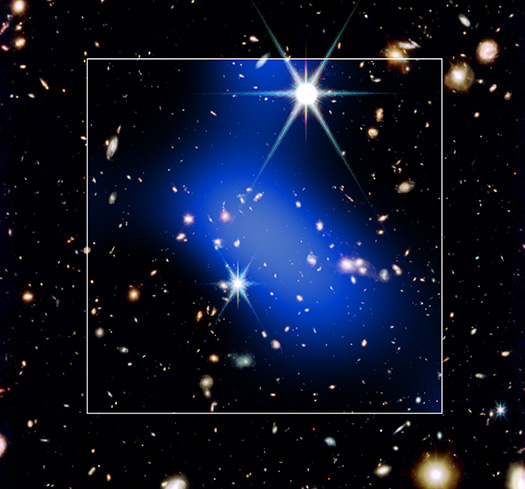
This graphic represents the discovery of what may be the most distant protocluster ever found, as described in our latest press release. By using NASA’s Chandra X-ray Observatory together with the James Webb Space Telescope (JWST), astronomers have netted an important piece in the history of the universe: when galaxy clusters, the largest structures held together by gravity, begin to form.
The main panel contains an infrared image from the JWST Advanced Deep Extragalactic Survey (JADES), a deep infrared imaging project that used more than a month of the telescope’s observing time. The white box outlines X-rays (blue) seen with Chandra.
NASA's Chandra Releases Deep Cut From Catalog of Cosmic Recordings

Sagittarius A*
More images, videos, and information
Credit: NASA/CXC/SAO;
Image Processing: NASA/CXC/SAO/N. Wolk
Like a recording artist who has had a long career, NASA’s Chandra X-ray Observatory has a “back catalog” of cosmic recordings that is impossible to replicate. To access these X-ray tracks, or observations, the ultimate compendium has been developed: the Chandra Source Catalog (CSC).
The CSC contains the X-ray data detected up to the end of 2020 by Chandra, the world’s premier X-ray telescope and one of NASA’s “Great Observatories.” The latest version of the CSC, known as CSC 2.1, contains over 400,000 unique compact and extended sources and over 1.3 million individual detections in X-ray light.
Within the CSC, there is a wealth of information gleaned from the Chandra observations — from precise positions on the sky to information about the the X-ray energies detected. This allows scientists using other telescopes — both on the ground and in space including NASA’s James Webb and Hubble Space Telescopes — to combine this unique X-ray data with information from other types of light.
The richness of the Chandra Source Catalog is illustrated in a new image of the Galactic Center, the region around the supermassive black hole at the center of the Milky Way galaxy called Sagittarius A*. In this image that spans just about 60 light-years across, a veritable pinprick on the entire sky, Chandra has detected over 3,300 individual sources that emit X-rays. This image is the sum of 86 observations added together, representing over three million seconds of Chandra observing time.