
SAO + NASM = FETTSS @ SI
For those of you who don’t like acronyms (or who don't work for the government), the title of this post is probably indecipherable. It does, however, have quite a bit of meaning.
The translation into English is "Smithsonian Astrophysical Observatory and National Air and Space Museum makes "From Earth to the Solar System at the Smithsonian Institution."
Chandra & the Carnival of Space
The Carnival of Space is a round up of astronomy and space-related blogs that started back in 2007. Every week, a different webmaster or blogger hosts the carnival, showcasing articles written on the topic of space. This week, it's our turn to host the Carnival here on the Chandra blog. Enjoy!
Welcome to this week’s Carnival of Space. We’ve got a lot to cover in the weekly blog carnival, so let’s jump right into it.
On WeirdWarp, Chris Dann features the latest view of the Centaurus A galaxy from the Hubble Space Telescope. This famous galaxy just seems to get better each time a telescope takes a new look.
Mike Simonsen at Simostronomy has an account of his recent trip to the Texas Star Party. Sounds like quite an event!
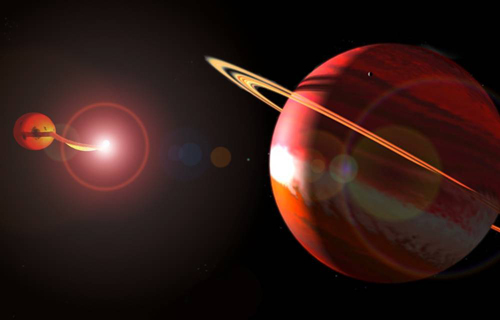
Over at Urban Astronomer, we find a write up of a newly discovered planetary system that didn't make too many headlines, but is fascinating nonetheless. This system apparently contains two giant planets around a pair of stars – a result that would have been pure science fiction just a few years ago.
Pandora's Cluster Revealed

One of the most complicated and dramatic collisions between galaxy clusters ever seen is captured in this new composite image. This collision site, known officially as Abell 2744, has been dubbed "Pandora's Cluster" because of the wide variety of different structures seen. Data from NASA's Chandra X-ray Observatory are colored red, showing gas with temperatures of millions of degrees. In blue is a map showing the total mass concentration (mostly dark matter) based on data from the Hubble Space Telescope (HST), the European Southern Observatory's Very Large Telescope (VLT), and the Japanese Subaru telescope. Optical data from HST and VLT also show the constituent galaxies of the clusters.
A Solar Flare That Will Blow Your Socks Off
By now many of you who follow the Sun have probably heard about the “solar flare that will blow your socks off,” which occurred in early morning of Sunday June 7. Here at the Chandra X-ray Center we watched it too -- with some pride as our colleagues downstairs with the Solar Dynamics Observatory were responsible for some of the movies that were being circulated around the Internet. On the one hand, an M2 is a medium-sized event and not usually a big deal. On the other hand, I also thought of a slogan written on my whiteboard a few years ago, “West limb worry.”
NASA's Chandra Finds Massive Black Holes Common in Early Universe
Correction: After this paper (Treister et al. 2011) was published and publicized a problem was discovered with the background subtraction used. Analysis by several groups, including the Treister et al. team, plus Willott (2011) and Cowie et al. (2012), shows that a significant detection of AGN (growing black holes) in the early universe can no longer be claimed.
Editor's Note: Honest errors such as this are part of the scientific process, especially on the frontiers of discovery. To quote Nobel laureate Frank Wilczek, "If you don't make mistakes, you're not working on hard enough problems. And that's a big mistake."
References:
Cowie, L. et al. 2012, ApJ, in press
https://arxiv.org/abs/1110.3326
Treister, E. et al. 2011, Nature, 474, 356
https://arxiv.org/abs/1106.3079
Willott, C. 2011, ApJ, 742, L8
https://arxiv.org/abs/1110.4118
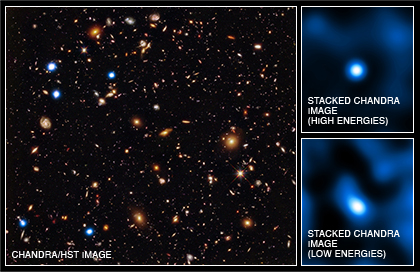
This composite image from NASA's Chandra X-ray Observatory and Hubble Space Telescope (HST) combines the deepest X-ray, optical and infrared views of the sky. Using these images, astronomers have obtained the first direct evidence that black holes are common in the early Universe and shown that very young black holes grew more aggressively than previously thought.
Black Hole Webchat Tomorrow
If you’re one who follows astro-news regularly, you’ve probably heard by now that there will be a Chandra press conference. While we can't give out too much information in advance, we can say that this press conference covers black holes in the early Universe. This event will be televised on NASA TV and anyone can watch it live, beginning at 1pm Eastern, and follow #babyblackholes on Twitter
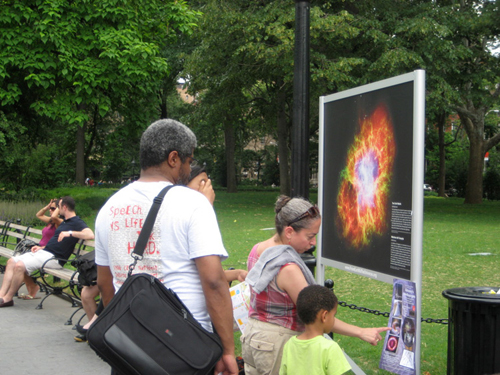
The AAS Comes to Boston
This week, the American Astronomical Society held its bi-annual meeting in the fair city of Boston. Since those of us involved with Chandra spend most of our time on the other side of the river (meaning Cambridge), this is a chance to expand our horizons ever so slightly.
Of course, the big bonus of the AAS meeting is the ability to hear talks and mingle with people who don’t work at our institution. It’s a chance to catch up with old colleagues and meet new ones. In a world increasingly dominating by electronic communication, there’s something irreplaceable about actually sitting across from someone in person.

Nearby Supernova Factory Ramps Up
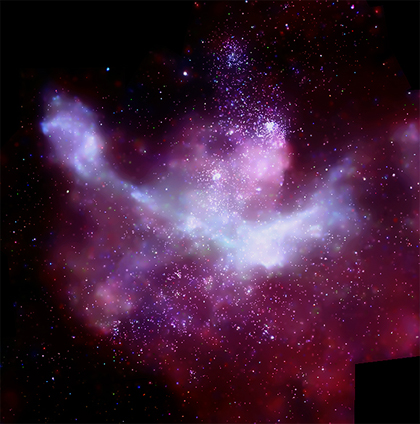
This large Chandra image shows the Carina Nebula, a star-forming region in the Sagittarius-Carina arm of the Milky Way a mere 7,500 light years from Earth. Chandra's sharp X-ray vision has detected over 14,000 stars in this region, revealed a diffuse X-ray glow, and provided strong evidence that massive stars have already self-destructed in this nearby supernova factory.
Chandra: Promises Made and Kept
A promise made is a debt unpaid. Robert Service
Chance favors the prepared mind. Louis Pasteur
Not long ago a request came down from above for a list of Chandra’s achievements that have “completely transformed the way we have viewed our world, solar system, sun, or universe."
In other words, how many discoveries of the century have you made this year?