Quasars & Active Galaxies
Chandra Reveals a Black Hole Jet around the “Red Potato,” an Early-Universe Galaxy Without Active Star Formation
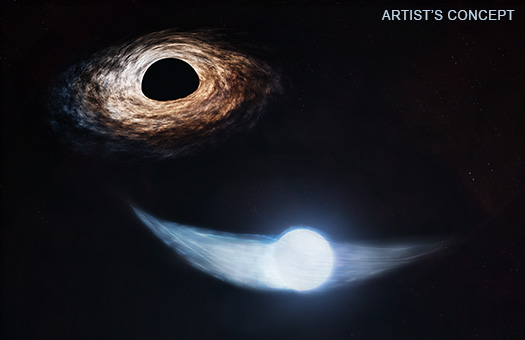
We welcome Weichen Wang as a guest blogger. Weichen is the first author of a paper that is the subject of our latest press release. He is a postdoctoral researcher at the University of Milano-Bicocca in Milan, and his research focuses on the relationship between galaxies in the early Universe and their large-scale environments. Before moving to Italy in 2022, he lived in Baltimore for six years and earned his PhD at the Johns Hopkins University. He received his bachelor’s degree from Tsinghua University in Beijing in 2016.

The history of galaxy formation is, in many ways, the story of diffuse cosmic gas being transformed into galactic stars. One important source of this fuel is the cool circumgalactic medium: gas surrounding galaxies that can eventually fall inward and help form new stars. Earlier observations showed that, in the early Universe, this cool gas is especially abundant in the densest intersections, or “nodes,” of the cosmic web. We therefore expected galaxies in these node regions to be actively forming stars.
Chandra Tracks the Evolving Jet from M87's Black Hole
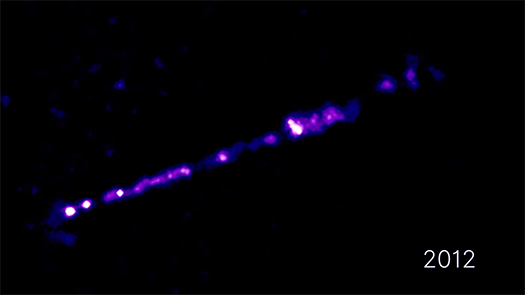
M87 Jet
More images, videos, and information
Credit: X-ray: NASA/CXC/Univ. Laval/C. Poitras et al.; Image Processing: NASA/CXC/SAO/A. Jubett, K. Arcand, and L. Frattare
Astronomers have produced the most detailed X-ray views ever obtained of the jet launched from the supermassive black hole at the center of Messier (M87), as reported in a press release from Laval University in Canada. The main video from NASA’s Chandra X-ray Observatory (purple) showing X-ray images taken in 2012, 2017, 2023 and 2025. Using advanced image-processing techniques, researchers have tracked the evolution of the jet structures in remarkable detail.
Messier 87 is located about 55 million light-years from Earth and has one of the largest known black holes — weighing some 6.5 billion times the mass of the Sun — in its core. This black hole was the first ever to have a direct image taken of it, by the Event Horizon Telescope and released in 2019. Prior to that, M87 was already very well known among astronomers for many reasons — including the spectacular jet that blasts away from the black hole.
NASA Connects Little Red Dots With Chandra, Webb

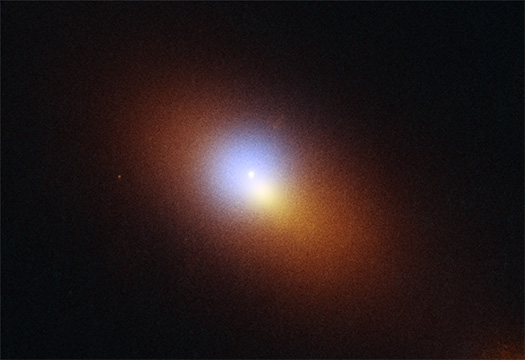
X-ray Dot 3DHST-AEGIS-12014
More images and information
Credit: X-ray: NASA/CXC/Max Plank Inst./R. Hviding et al.; Optical/IR; NASA/ESA/STScI/HST;
Image Processing: NASA/CXC/SAO/N. Wolk
This image of a special object, dubbed the “X-ray dot,” represents a discovery from NASA’s Chandra X-ray Observatory that could help explain the nature of a mysterious class of sources in the early Universe as described in our latest press release. Officially known as 3DHST-AEGIS-12014, the X-ray dot is located about 11.8 billion light-years from Earth and may provide a crucial bridge between young black holes embedded in dense gas and typical growing supermassive black holes.
Chandra Explains Why Black Hole Growth Slowed Since Cosmic Noon

Zhibo Yu
We welcome Zhibo Yu as our guest blogger. He is the first author of a paper that is the subject of our latest Chandra press release and is a fourth-year PhD student in the Department of Astronomy and Astrophysics at Penn State University, where he works with Prof. Niel Brandt on surveys of active galactic nuclei. His research primarily focuses on the coevolution of supermassive black holes and their host galaxies. Zhibo joined Penn State in 2022. Before that, he earned his B.S. degree in physics from Fudan University, China, where he worked with Prof. Cosimo Bambi on black-hole X-ray binaries
In the late 1950s, astronomers began to discover powerful radio sources in the sky with very small angular sizes in visible light. These strange “star-like” objects were later known as “quasi-stellar objects” (QSOs), or quasars, which are very far away from our own Galaxy and are extremely luminous. Afterwards, in the early 1970s, Dutch-born American astronomer Maarten Schmidt was among the first to find that quasars appear to be more abundant when they are farther away from us.
Today, astronomers believe that these luminous quasars are powered by actively growing supermassive black holes (SMBHs) in the centers of galaxies. Many growing SMBHs are not as bright as quasars and are generally referred to as active galactic nuclei (AGNs). When astronomers observe distant growing SMBHs, they are also looking back in time because light takes time to travel from these black holes to us. The farther away a black hole is, the earlier in cosmic history we are seeing it.
Chandra Reveals an Extremely Fast Accreting Black Hole in the Early Universe

Luca Ighina, postdoctoral fellow at the Center for Astrophysics | Harvard and Smithsonian
We are happy to welcome Luca Ighina as a guest blogger. Luca is a postdoctoral fellow at the Center for Astrophysics | Harvard and Smithsonian and the first author of a paper that is the subject of our latest Chandra press release. In his research he studies the most distant supermassive black holes with a focus on those able to expel part of the material they are pulling inwards in the form of jets moving at close to the speed of light. To this end he uses the most sensitive telescopes around the world covering the entire electromagnetic spectrum, from the radio to the optical-near-infrared to the X-ray band. He received his PhD from the Insubria University (Como, Italy), where he mainly worked at the INAF institute in Milano-Brera (Italy), along with a one-year visit to the ICRAR institute for radio astronomy in Perth (Western Australia).
How do supermassive black holes grow in the early Universe?
Most galaxies observed in the Universe host a supermassive black hole at their center. Some of them, called active galactic nuclei (AGN) or quasars, grow in mass as surrounding material falls inwards through a process called accretion. Astronomers have found some extreme examples of quasars that can reach masses of several billion times that of the Sun, only one billion years after the Big Bang. Understanding how these black holes formed and grew so rapidly remains one of the major open questions in modern astrophysics.
NASA Telescopes Pinpoint Free-Roaming Massive Black Hole
Tidal Disruption Event AT2024tvd
Credit: X-ray: NASA/CXC/SAO/Univ. of California, Berkeley/Y. Yao et al.; Optical/UV: NASA/ESA/STScI/HST; Image Processing: NASA/STScI/J. DePasquale
Astronomers have discovered a black hole has torn apart a star (a phenomenon called a tidal disruption event, or TDE) in a surprising location, as described in this press release. This event occurred about 2,600 light-years away from the center of the black hole’s host galaxy, indicating the presence of a second large black hole. Most TDEs have been detected at the centers of galaxies where supermassive black holes are usually found.
A TDE happens when an infalling star is stretched or “spaghettified” by a black hole’s immense gravitational tidal forces. The shredded stellar remnants are pulled into a circular orbit around the black hole. This generates shocks and outflows with high temperatures that can be seen in ultraviolet and visible light. X-rays are produced when material from the destroyed star falls toward the black hole and is heated to millions of degrees.
Chandra Sees Black Hole Jet Stumble Into Something in the Dark

Even matter ejected by black holes can run into objects in the dark. Using NASA’s Chandra X-ray Observatory, astronomers have found an unusual mark from a giant black hole’s powerful jet striking an unidentified object in its path.
The discovery was made in a galaxy called Centaurus A (Cen A), located about 12 million light-years from Earth. Astronomers have long studied Cen A because it has a supermassive black hole in its center sending out spectacular jets that stretch out across the entire galaxy. The black hole launches this jet of high-energy particles not from inside the black hole, but from intense gravitational and magnetic fields around it.
Black Hole Destroys Star, Goes After Another, NASA Missions Find
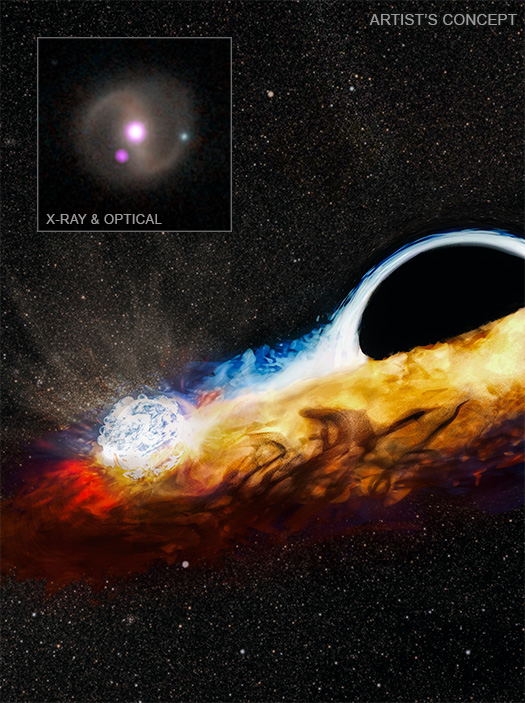
AT2019qiz
Credit: X-ray: NASA/CXC/Queen's Univ. Belfast/M. Nicholl et al.; Optical/IR: PanSTARRS, NSF/Legacy Survey/SDSS; Illustration: Soheb Mandhai / The Astro Phoenix; Image Processing: NASA/CXC/SAO/N. Wolk
NASA’s Chandra X-ray Observatory and other telescopes have identified a supermassive black hole that has torn apart one star and is now using that stellar wreckage to pummel another star or smaller black hole, as described in our latest press release. This research helps connect two cosmic mysteries and provides information about the environment around some of the bigger types of black holes.
This artist’s illustration shows a disk of material (red, orange, and yellow) that was created after a supermassive black hole (depicted on the right) tore apart a star through intense tidal forces. Over the course of a few years, this disk expanded outward until it intersected with another object — either a star or a small black hole — that is also in orbit around the giant black hole. Each time this object crashes into the disk, it sends out a burst of X-rays detected by Chandra. The inset shows Chandra data (purple) and an optical image of the source from Pan-STARRS (red, green, and blue).
Chandra Teams Up Again With Astrophotographers
Messier 106 (M106), also known as NGC 4258, is a spiral galaxy – like our own Milky Way -- located in the constellation Canes Venatici. It lies at a distance of roughly 23 million light-years and spans some 135,000 light-years in diameter.
This galaxy is famous, however, for something that our Galaxy doesn’t have – two extra spiral arms that glow in X-ray, optical, and radio light. These features, called anomalous arms, are not aligned with the plane of the galaxy, but instead intersect with it. The X-ray image from Chandra reveals huge bubbles of hot gas above and below the plane of the galaxy. These bubbles indicate that much of the gas that was originally in the disk of the galaxy has been heated to millions of degrees and ejected into the outer regions by the jets from a supermassive black hole at the galaxy’s core.
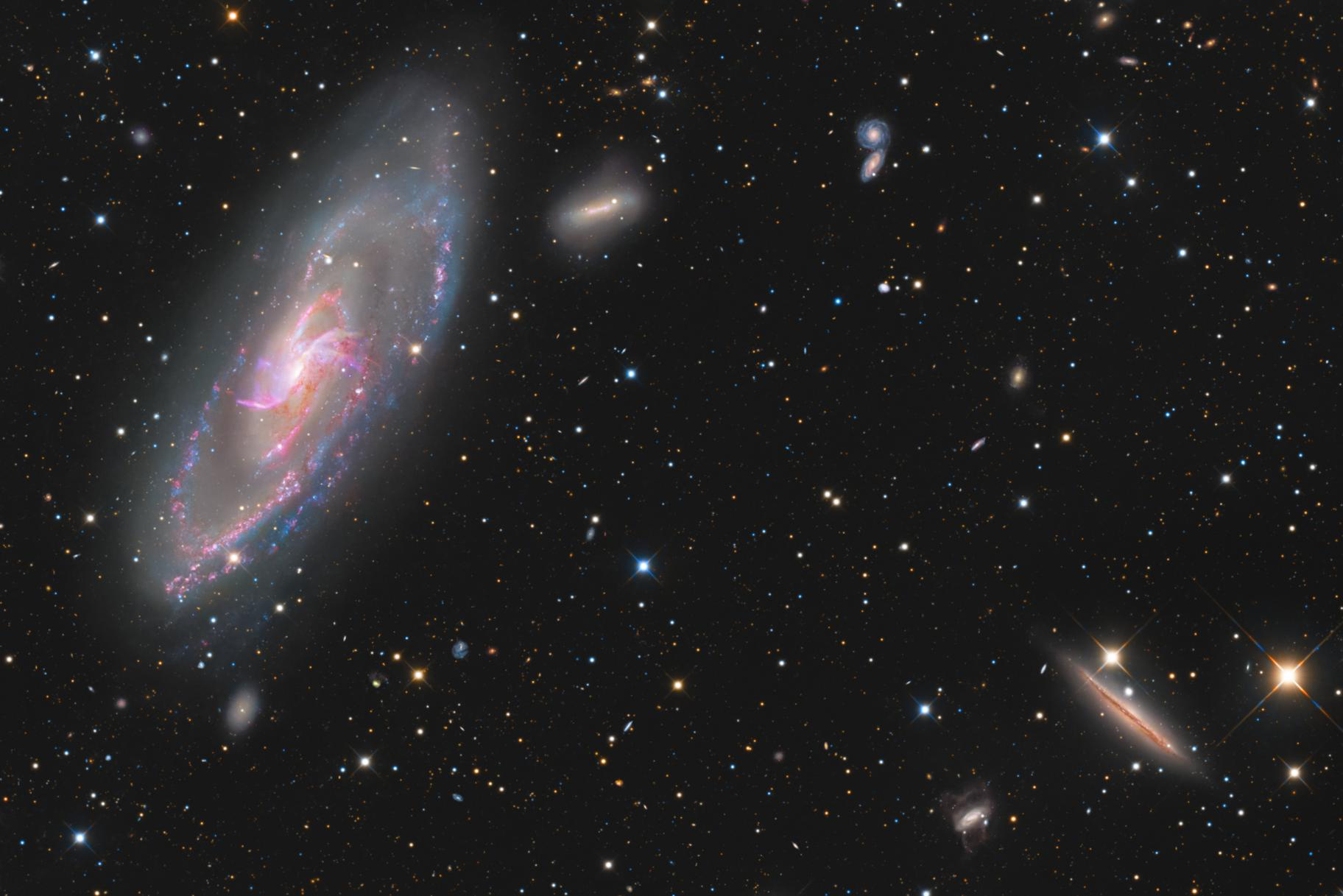
Credit: Optical: Deep Sky Collective; Chandra X-ray (purple): NASA/CXC/SAO;
VLA Radio (yellow): NSF/NRAO/VLA; Spitzer IR (Red): NASA/JPL-Caltech
It's not only space-based X-ray telescopes like Chandra, however, that have looked at M106. Excellent work has been done from the ground including by amateur astrophotographers including a group called the Deep Sky Collective (DSC). The DSC, founded by Tim Schaeffer in 2023, aims to use the group’s telescopes in a concerted way to explore some of the faintest and most difficult target in the sky in great detail.