
Fingers, Loops and Bays in The Crab Nebula
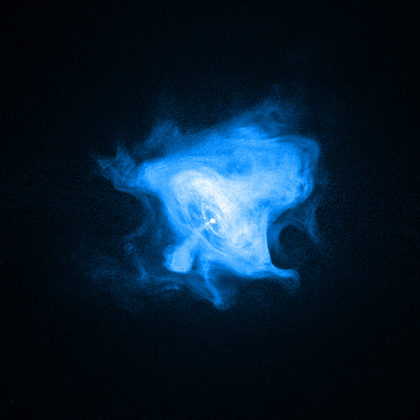
Crab Nebula: A supernova remnant and pulsar located 6000 light years from Earth in the constellation of Taurus. More at https://chandra.harvard.edu/photo/2008/crab/
From One X-ray Mission to Another
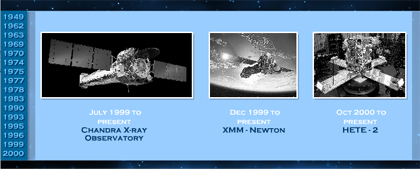
As many of this blog's readers may know, Chandra is NASA's flagship X-ray mission but it's not the only major X-ray telescope in orbit. The other one is XMM-Newton, which was launched by the European Space Agency (ESA) just five months after Chandra in 1999. The great thing about Chandra and XMM-Newton is that many of their capabilities are complementary. In other words, scientists often use both and can combine the data for even stronger results.
Aesthetics & Astronomy
Here at the Chandra X-ray Center, we work hard to make the images that you find on the public website. No, there’s no magic button that we push to make pretty pictures. In fact, there are countless keystrokes, mouse movements, and lots of thinking that go into these images of the cosmos that are fit for public consumption.
Chandra joins the Flickr Commons project with the Smithsonian
Not to give away my age, but I remember not too long ago using film when I took pictures. And then having (gasp!) to get them developed. It was a sad, sad world, but somehow we emerged into our current age of electronic enlightenment.
One of the greatest advantages of digital visualization, in my opinion, is the ability to share, comment on, and arrange images in a myriad of ways. And, of course, Flickr has been highly successful at taking these concepts to a new level.
Cast Your Vote!

In case you haven't heard, there's an election going on. No, not that election. This one goes beyond national politics and covers the entire Galaxy and beyond.
A Long Look Back at History
Fifty years ago this week, on October 1st, the legislation creating the National Aeronautics and Space Administration, or NASA, was enacted. There will likely be a lot of buzz about this anniversary, and rightly so, since it has, among many other things, shaped our understanding of the Universe so dramatically.
Chandra's Got A New Look
The Chandra X-ray Observatory Center web site chandra.harvard.edu has been in existence for over ten years. In that time the Chandra Education & Public Outreach team has worked to improve content delivery, utilize new technologies and attempt to provide a fun, educational experience. Last week, the web group released a major revision that kept the overall basic design, navigation and search principles intact while allowing greater user control in content delivery. The new graphical design builds on existing elements but lends a more modern look.
The Chandra Astrophysics Institute, Part III
Sambath Kol (known as Simba) relates his experiences with the Chandra Astrophysics Institute in this third article of the series. (Continued from Part II)
-------------
The Chandra Astrophysics Institute, Part II
Peter Ashton relates his experiences with the Chandra Astrophysics Institute as an assistant instructor and as a former student. (Continued from Part I)
---------------
The Chandra Astrophysics Institute
The Chandra Astrophysics Institute (CAI), a Chandra X-ray Observatory-sponsored program run by the MIT Kavli Institute for Astrophysics and Space Research, is intended for students from the Boston area from a wide range of academic backgrounds with a limited opportunity to directly experience authentic science. Students may be interested in exploring a science career, or looking to develop research, technology and collaboration skills valuable for college or work in ANY field.