
Normal Stars & Star Clusters
NASA Telescopes Create Colorful 'Craft' From Nearby Nebula

Tarantula Nebula / 30 Doradus
More images, videos, and information
Credit: X-ray: NASA/CXC/Ohio State Univ./J. Rodriguez et al; Infrared: NASA/ESA/CSA/STScI; Optical: NASA/ESA/STScI; Image Processing: NASA/CXC/SAO/P. Edmonds
Like a collage made of layered sheets of colored cellophane, a vibrant new image layers observations of a famous star-forming nebula from NASA space telescopes. The resulting cosmic “craft” reveals new details about the star formation region known as 30 Doradus, or the Tarantula Nebula.
Located in the Large Magellanic Cloud, a small neighbor galaxy to the Milky Way about 160,000 light-years from Earth, the Tarantula has thousands of young stars embedded in a vibrant honeycomb-like structure of gas and dust.
The new composite image contains X-rays from NASA’s Chandra X-ray Observatory, which has repeatedly observed the Tarantula Nebula over the course of its mission, in the layer that appears in blue. The X-ray data reveals gas blown away by winds from the surfaces of young, massive stars and heated to millions of degrees by shock waves, like sonic booms from supersonic jets.
The red represents infrared data from NASA’s James Webb Space Telescope showing thousands of young stars, plus swaths of cool dust that will provide the ingredients to form new stars and planets. Optical data in the green layer from NASA’s Hubble Space Telescope uncovers hydrogen gas that is warmer than seen with Webb, as well as some individual stars through the nebula.
The composite image shows the full Hubble and Webb images of this region, as well as a large section of the Chandra image, all recently published in a research paper in the Astrophysical Journal. In some regions the blue Chandra layer stands alone, and in others it combines with either the red Webb data or the green Hubble data. In the middle region all three images overlap to provide a holistic view in red, orange, yellow, green, and blue.
NASA Finds Young Stars Dim in X-rays Surprisingly Quickly

Trumpler 3 and NGC 2353
More images and information
Credit: X-ray: NASA/CXC/Penn State Univ/K. Getman; Optical/IR: PanSTARRS;
Image Processing: NASA/CXC/SAO/N. Wolk
These images of star clusters represent a new study from NASA’s Chandra X-ray Observatory that shows how young Sun-like stars are dimmer in X-rays than previously thought. As described in our latest press release, this result has implications for the prospects of life developing and surviving on planets in orbit around these stars.
Trumpler 3 and NGC 2353 are so-called open clusters that contains hundreds of young stars. These stars are tied to each other through gravity, having been formed from the same clouds of gas. Many of these stars have masses that are similar to our Sun, but are much younger. In these new composite images of Trumpler 3 and NGC 2353, X-rays from Chandra (purple) have been combined with an optical image from the PanSTARRS telescope in Hawaii (red, green, and blue). Another star clusters from the new Chandra study, NGC 2301 is shown in the same color schemes with the X-ray and optical data.
Spring Collection: Spring Has Sprung in Space (As Always)
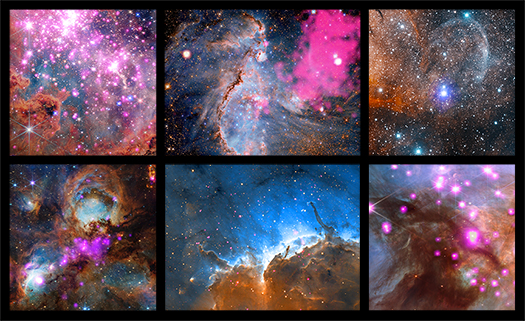
In the Northern Hemisphere this week, the calendar officially passes from winter into spring when the length of the day and the night become equal as the days become longer. Meanwhile, there are places in space where blooms of the stellar variety are always growing.
This collection of images from NASA’s Chandra X-ray Observatory and other telescopes contains regions where stars are forming. Often nicknamed “stellar nurseries,” they are cosmic gardens from which stars – not plants – emerge from the interstellar soil of gas and dust. X-rays are energetic enough that they can penetrate the gas and dust of these stellar nurseries, giving insight to the young stars and other high-energy phenomena that are happening within, including the effects of X-rays on any planets or planet-forming disks orbiting stars.
Young "Sun" Caught Blowing Bubbles by NASA's Chandra

HD 61005
More images, videos, and information
Credit: X-ray: NASA/CXC/John Hopkins Univ./C.M. Lisse et al.; Infrared: NASA/ESA/STIS; Optical: NSF/NoirLab/CTIO/DECaPS2;
Image Processing: NASA/CXC/SAO/N. Wolk
This image contains the first astrosphere, or wind-blown bubble, that astronomers have captured surrounding a star that is a younger version of our Sun. This discovery was made using NASA’s Chandra X-ray Observatory and is described in our latest press release.
The astrosphere was found around a star called HD 61005, which is located only about 120 light-years from Earth. HD 61005 has roughly the same mass and temperature as the Sun but is much younger with an age of about 100 million years, compared to the Sun’s age of about 5 billion years. This commonality with the Sun is important because the Sun has a similar bubble, which scientists call the heliosphere. The discovery of the astrosphere around HD 61005 gives astronomers a chance to study a structure that may be similar to what the Sun was embedded in several billion years ago.
A Cosmic Heart Where New Stars Thrive

Cocoon Nebula
More images and information
Credit: X-ray: NASA/CXC/SAO; Infrared: NASA/JPL/Caltech(WISE); Optical: M. Adler, B. Wilson;
Image Processing: NASA/CXC/SAO/L. Frattare
To celebrate Valentine's Day, we are releasing a new image of the Cocoon Nebula (officially named IC 5146). This heart-shaped nebula is a region in the Milky Way galaxy where new stars are forming. X-ray data from NASA’s Chandra X-ray Observatory (red, green, and blue) reveal a cluster of new stars that are just poking through the stunning nebula. Young stars, like those in the Cocoon Nebula, are very active and give off large amounts of X-rays that Chandra can detect.
NASA's Chandra Finds Small Galaxies May Buck the Black Hole Trend

NGC 6278 and PGC 039620
More images, videos, and information
Credit: X-ray: NASA/CXC/SAO/F. Zou et al.; Optical: SDSS; Image Processing: NASA/CXC/SAO/N. Wolk
This two-panel graphic represents the results of a new study that suggests that smaller galaxies do not contain supermassive black holes nearly as often as larger galaxies do. The new study, as described in our latest press release, analyzed over 1,600 galaxies that have been observed with NASA’s Chandra X-ray Observatory over two decades. The findings imply that most smaller galaxies likely do not have supermassive black holes in their centers, which is in contrast with the common idea that nearly every galaxy has one of these giant black holes within their cores.
The two galaxies shown here, NGC 6278 and PGC 039620, are representative of the galaxies in the study. In optical and X-ray images (X-rays are purple), both galaxies are seen in optical light data from the Sloan Digital Sky Survey. The insets contain just the X-ray data from Chandra. NGC 6278 is roughly the same size as our home galaxy and has X-rays detected from its core. PGC 03620 on the other hand is a smaller galaxy — only a fraction of the size of the Milky Way — and does not show any evidence of an X-ray source.
Fall Collection: Before Fall Leaves, See Seasonal Offerings from NASA's Chandra

Before fall gives way to winter in the northern hemisphere, NASA’s Chandra X-ray Observatory has several images that celebrate autumn and its many delights to share. In spirit of the season, this collection gathers Chandra data with those from its telescopic family including NASA’s James Webb, Hubble, and Spitzer Space Telescopes, plus others in space and on the ground.
NASA's Chandra Finds Baby Exoplanet is Shrinking

TOI 1227 / TOI 1227 b
More images, videos, and information
Credit: X-ray: NASA/CXC/RIT/A. Varga et al.; Illustration: NASA/CXC/SAO/M. Weiss; Image Processing: NASA/CXC/SAO/N. Wolk
A star is unleashing a barrage of X-rays that is causing a closely-orbiting, young planet to wither away an astonishing rate, according to a new study using data from NASA’s Chandra X-ray Observatory and described in our latest press release. A team of researchers has determined that this planet will go from the size of Jupiter down to a small, barren world.
NASA Telescopes Deliver Stellar Bouquet in Time for Valentine's Day
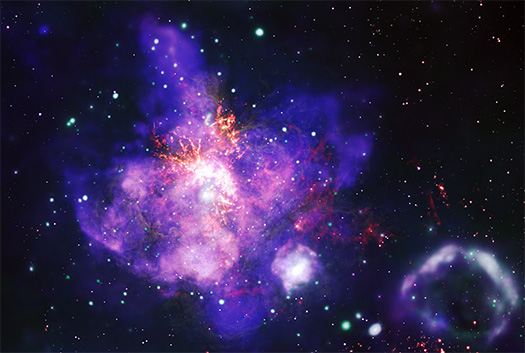
30 Doradus
Credit: X-ray: NASA/CXC/Penn State Univ./L. Townsley et al.; Infrared: NASA/JPL-CalTech/SST;
Optical: NASA/STScI/HST; Radio: ESO/NAOJ/NRAO/ALMA; Image Processing: NASA/CXC/SAO/J. Schmidt, N. Wolk, K. Arcand
A bouquet of thousands of stars in bloom has arrived. This composite image contains the deepest X-ray image ever made of the spectacular star forming region called 30 Doradus.
By combining X-ray data from NASA’s Chandra X-ray Observatory (blue and green) with optical data from NASA’s Hubble Space Telescope (yellow) and radio data from the Atacama Large Millimeter/submillimeter Array (orange), this stellar arrangement comes alive.
Exoplanets Need to be Prepared for Extreme Space Weather, Chandra Finds
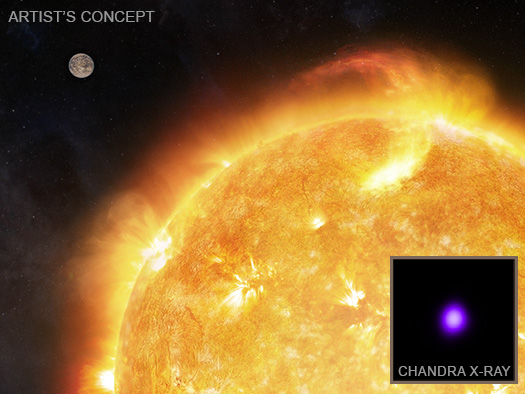
Illustration of Wolf 359 with Chandra X-ray Inset
Credit: X-ray: NASA/CXC/SAO/S.Wolk, et al.; Illustration: NASA/CXC/SAO/M.Weiss; Image processing: NASA/CXC/SAO/N. Wolk
This artist’s illustration represents the results from a new study that examines the effects of X-ray and other high-energy radiation unleashed on potential exoplanets from a host star. As outlined in our latest press release, astronomers using NASA’s Chandra X-ray Observatory and ESA’s XMM-Newton observed Wolf 359, a red dwarf that is only 7.8 light-years from Earth, making it one of the closest stars to the Earth other than the Sun.
The artist’s rendering shows Wolf 359 in the foreground and a potential planet in orbit around it in the background. Red dwarfs are the most common type of star in the Universe. They are much smaller and dimmer than Sun-like stars, which allows them to last for trillions of years. This would give planets in orbit around them ample time for life to form and emerge, which makes them particularly interesting to scientists looking for life beyond the Solar System.