
Neutron Stars/X-ray Binaries
The Supernova Impostor With a Hidden Partner

Mojgan Aghakhanloo (Credit: Mojgan Aghakhanloo)
We are pleased to welcome our guest blogger, Mojgan Aghakhanloo, who leads a new paper that is the subject of our latest Chandra press release. She is currently a VITA–Origins Fellow in the Department of Astronomy at the University of Virginia (UVA), and before joining UVA, she was a postdoctoral researcher at the University of Arizona. She earned her Ph.D. from Florida State University in 2020 and her bachelor’s degree in Iran, where she is originally from. Her research focuses on non-terminal outbursts of massive stars, which she studies at optical, X-ray, and radio wavelengths.
Stars that fake their own deaths
When astronomers search the sky for supernovae (that is, explosions of stars), they sometimes find outbursts that look like the death of a massive star. However, some turn out to be something even stranger. These events are fainter and less energetic than true supernovae, and the star is expected to survive. Astronomers call them “supernova impostors”: non-fatal outbursts from some of the most massive stars in the Universe.
Supernova impostors are often associated with stars known as luminous blue variables (LBVs). These are hot, bright, and massive stars that can undergo dramatic changes in brightness and shed enormous amounts of material into space. The most famous LBV in our Galaxy is Eta Carinae. During its “Great Eruption” in the 1840s, Eta Carinae expelled more than ten times the mass of the Sun and briefly became one of the brightest stars in the night sky.
The Cosmic Wake of the Lighthouse Pulsar
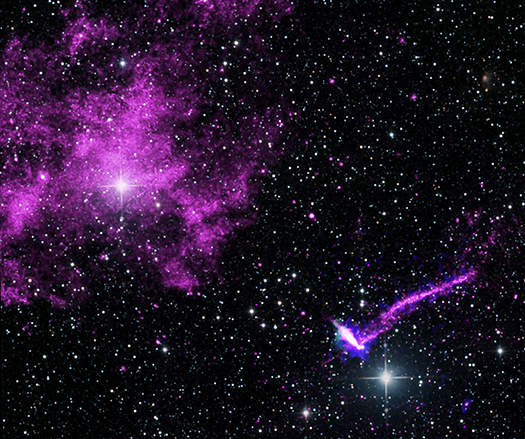
Lighthouse Pulsar (PSR J1101-6101)
More images and information
Credit: X-ray: Chandra: NASA/CXC/Stanford Univ./J. Dinsmore et al.; IXPE: NASA/MSFC/J. Dinsmore et al., Radio: CSIRO/ATNF/ATCA; Optical: 2MASS/UMass/IPAC-Caltech/NASA/NSF;
Image Processing: NASA/CXC/SAO/L. Frattare
Scientists using NASA’s IXPE (Imaging X-ray Polarimetry Explorer) directly measured the magnetic fields of PSR J1101−6101, a pulsar located within what is often referred to as the “Lighthouse” Nebula, for the first time.
A pulsar is a type of neutron star — the dense core leftover when a massive star collapses — with a strong magnetic field that spins incredibly fast. The pulsar at the center of the Lighthouse nebula is rotating at 16 times per second.
Astronomers studied two narrow offshoots extending from the Lighthouse pulsar to better understand how electrons at nearly the speed of light interact with the surrounding environment. When high-energy particles from the pulsar collide with the gas of interstellar space, they form a bow shock similar to the bow wave formed at the front of a speeding boat. Most particles become trapped behind this bow shock, forming the turbulent tail behind the pulsar. Previously, NASA’s Chandra X-ray Observatory captured this tail that extends for over 37 light-years, the longest jet from an object seen in the Milky Way at the time.
How the Most Energetic Explosions in the Universe Are Formed

Simone Dichiara
We welcome Simone Dichiara as a guest blogger. Simone is the first author of a paper that is the subject of our latest press release. He is an Assistant Research Professor at Penn State University and currently works at the Mission Operations Center of the Neil Gehrels Swift Observatory, where he serves as an Observational Duty Scientist and as Instrument Scientist for the X-Ray Telescope (XRT) onboard. Since the early years of his master’s degree, Simone has focused his research on a particular class of astrophysical transient sources known as Gamma-Ray Bursts (GRBs), which are among the most energetic explosions in the Universe. His research continued during his Ph.D. at the University of Ferrara, under the supervision of Cristiano Guidorzi and Lorenzo Amati, and throughout his postdoctoral appointments at the National Autonomous University of Mexico and at NASA Goddard Space Flight Center. He has extensive experience in observational time-domain astronomy and has been directly involved in observational campaigns using several ground- and space-based observatories operating across a broad range of wavelengths, from the optical band to very high-energy gamma rays. He has served as Principal Investigator (PI) or Co-Investigator (Co-I) on multiple approved observing programs with the Chandra X-ray Observatory.
Neutron stars are among the most extreme objects known in astrophysics. These compact stars are formed in the explosive deaths of massive stars and compress down to become between 1.4 and 2 times the mass of the Sun into a sphere only tens of kilometers across (roughly the size of a city). Their density is so high that a single teaspoon of neutron star material would weigh billions of tons.
When two of these cosmic monsters orbit each other and eventually collide, they produce extremely powerful bursts of radiation called "gamma-ray bursts," (GRBs) which are among the most luminous electromagnetic events in the Universe. These brief flashes of extremely energetic gamma-ray radiation can momentarily outshine all other sources in the sky detected by gamma ray space-based observatories. Although they last from only a fraction of a second to a few minutes, during that time they can release as much energy as the Sun will emit over its entire lifetime.
NASA's Chandra Diagnoses Cause of Fracture in Galactic "Bone"
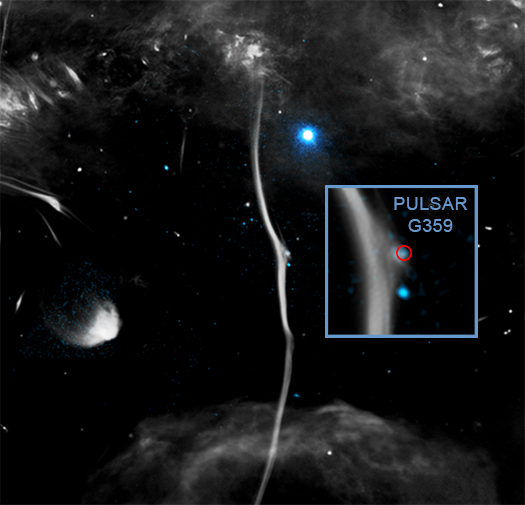
G359.13142-0.20005
Credit: X-ray: NASA/CXC/Northwestern Univ./F. Yusef-Zadeh et al; Radio: NRF/SARAO/MeerKat; Image Processing: NASA/CXC/SAO/N. Wolk
Astronomers have discovered a likely explanation for a fracture in a huge cosmic “bone” in the Milky Way galaxy, using NASA’s Chandra X-ray Observatory and radio telescopes.
The bone appears to have been struck by a fast-moving, rapidly spinning neutron star, or pulsar. Neutron stars are the densest known stars and form from the collapse and explosion of massive stars. They often receive a powerful kick from these explosions, sending them away from the explosion’s location at high speeds.
NASA's Chandra, Hubble Tune Into 'Flame-Throwing' Guitar Nebula

Pulsar B2224+65 and the “Guitar Nebula”
Credit: X-ray: NASA/CXC/Stanford Univ./M. de Vries et al.; Optical: (Hubble) NASA/ESA/STScI and (Palomar) Hale Telescope/Palomar/CalTech; Image Processing: NASA/CXC/SAO/L. Frattare
Normally found only in heavy metal bands or certain post-apocalyptic films, a “flame-throwing guitar” has now been spotted moving through space. Astronomers have captured movies of this extreme cosmic object using NASA’s Chandra X-ray Observatory and Hubble Space Telescope.
The new movie of Chandra (red) and Palomar (blue) data helps break down what is playing out in the Guitar Nebula. X-rays from Chandra show a filament of energetic matter and antimatter particles, about two light-years or 12 trillion miles long, blasting away from the pulsar (seen as the bright white dot connected to the filament).
Chandra Peers Into Densest and Weirdest Stars
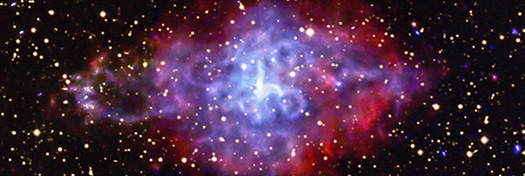
3C 58
Credit: X-ray: NASA/CXC/ICE-CSIC/A. Marino et al.; Optical: SDSS; Image Processing: NASA/CXC/SAO/J. Major
The supernova remnant 3C 58 contains a spinning neutron star, known as PSR J0205+6449, at its center. Astronomers studied this neutron star and others like it to probe the nature of matter inside these very dense objects. A new study, made using NASA’s Chandra X-ray Observatory and ESA’s XMM-Newton, reveals that the interiors of neutron stars may contain a type of ultra-dense matter not found anywhere else in the Universe.
In this image of 3C 58, low-energy X-rays are colored red, medium-energy X-rays are green, and the high-energy band of X-rays is shown in blue. The X-ray data have been combined with an optical image in yellow from the Digitized Sky Survey. The Chandra data show that the rapidly rotating neutron star (also known as a “pulsar”) at the center is surrounded by a torus of X-ray emission and a jet that extends for several light-years. The optical data shows stars in the field.
X-raying the Magnetic Field Bones of the Cosmic Hand

Roger Romani
We welcome Roger W. Romani as a guest blogger. Roger is the first author of a paper that is the subject of our latest Chandra release. He has been a professor of Physics at Stanford University for 30-odd years and helped found KIPAC, its institute focusing on astrophysics and cosmology. He is interested in high energy astrophysics problems of all sorts and likes to bring observations from multiple wavebands together with modeling to explain astrophysical puzzles. However, he has a special fondness for the extreme physics conditions associated with pulsars and their environments. Today’s blog gives one such example.
Magnetic fields are the binding agent that turn interstellar atoms into gases. Between the stars the particle density is so low that, without these fields, individual atoms would fly along like buckshot, essentially never colliding. But since the atoms are often ionized – with a positive charge because negatively charged electrons have been stripped away – their interaction with embedded magnetic fields forces them to flow in concord, resulting in the fluid-like behavior that forms many of the nebulas that enthrall us in astronomical images.
It is surprisingly hard to image this magnetic scaffolding. A new capability for magnetic mapping was introduced with the launch of NASA’s Imaging X-ray Polarimetry Explorer (IXPE) in late 2021. This telescope is sensitive to 1-10 keV X-rays and, using an ingenious photo-electron tracking camera developed by our Italian colleagues, is able to sense the polarization, or orientation of the electric field in the electromagnetic wave, of the individual X-ray events. (An “eV” is an electron volt, a unit that represents how much energy an electron gains when it is accelerated by the potential of one volt. A “keV” is 1000 eV.) So together with its imaging, timing, and energy resolution capabilities, IXPE can, for the first time, extract (albeit imperfectly) all of the information carried by each X-ray photon. The result is a color movie of the target, which also shows how the local emission is polarized.
Tiny Star Unleashes Gargantuan Beam of Matter and Antimatter

PSR J2030+4415
Credit: X-ray: NASA/CXC/Stanford Univ./M. de Vries; Optical: NSF/AURA/Gemini Consortium
This image from NASA's Chandra X-ray Observatory and ground-based optical telescopes shows an extremely long beam, or filament, of matter and antimatter extending from a relatively tiny pulsar, as reported in our latest press release. With its tremendous scale, this beam may help explain the surprisingly large numbers of positrons, the antimatter counterparts to electrons, scientists have detected throughout the Milky Way galaxy.
The panel on the left displays about one third the length of the beam from the pulsar known as PSR J2030+4415 (J2030 for short), which is located about 1,600 light years from Earth. J2030 is a dense, city-sized object that formed from the collapse of a massive star and currently spins about three times per second. X-rays from Chandra (blue) show where particles flowing from the pulsar along magnetic field lines are moving at about a third the speed of light. A close-up view of the pulsar in the right panel shows the X-rays created by particles flying around the pulsar itself. As the pulsar moves through space at about a million miles an hour, some of these particles escape and create the long filament. In both panels, optical light data from the Gemini telescope on Mauna Kea in Hawaii have been used and appear red, brown, and black. The full length of the filament is shown in a separate image.

Chandra Studies Extraordinary Magnetar

Magnetar J1818.0-1607
Credit: X-ray: NASA/CXC/Univ. of West Virginia/H. Blumer;
Infrared (Spitzer and Wise): NASA/JPL-CalTech/Spitzer
In 2020, astronomers added a new member to an exclusive family of exotic objects with the discovery of a magnetar. New observations from NASA's Chandra X-ray Observatory help support the idea that it is also a pulsar, meaning it emits regular pulses of light.
Magnetars are a type of neutron star, an incredibly dense object mainly made up of tightly packed neutrons, which forms from the collapsed core of a massive star during a supernova.
What sets magnetars apart from other neutron stars is that they also have the most powerful known magnetic fields in the Universe. For context, the strength of our planet's magnetic field has a value of about one Gauss, while a refrigerator magnet measures about 100 Gauss. Magnetars, on the other hand, have magnetic fields of about a million billion Gauss. If a magnetar was located a sixth of the way to the Moon (about 40,000 miles), it would wipe the data from all of the credit cards on Earth.