
Cosmic Pitch

Whether it’s a ball rocketing toward the net or a star shooting across the cosmos, both soccer and space are full of motion, energy, and force. Cosmic Pitch connects the world’s most popular sport to the universal language of physics — revealing how the same scientific principles that shape the beautiful game also govern our Universe.

On the field, players rely on data, angles, timing, and experience to predict where the ball will go next. Scientists use telescopes to see different forms of light including radio, infrared, visible ultraviolet, X-ray, and gamma-ray light. Each type of light, captured by different telescopes such as NASA’s Chandra X-ray Observatory, James Webb Space Telescope or Solar Dynamics Observatory, reveals something new about the cosmos.

From the spin of a curving free kick to the forces swirling around a black hole, the science on the field echoes across galaxies. As the world takes the field, see what happens when science is in play.

Distance

Definition: how far away an object is or the amount of ground an object has covered in its motion

Distance can be described as the ground covered between two points. Light itself travels nearly 300,000 kilometers every second, covering 150 million kilometers between the Sun and Earth in about 8 minutes. From pitch to planet, distance defines the scale of every journey.

Units: meter (m), kilometers (km), feet, miles, light years (A light year is the distance light travels in a year, about 6 trillion miles/ 9.5 trillion km).

COSMIC EXAMPLE

The Sun is our nearest star, with its light traveling about 650 million mph (1.1 billion kph), covering the 93 million miles (150 million km) in about 8 minutes Earth — a cosmic distance that sets the rhythm for life, seasons, and the scale of our solar system.

SOCCER EXAMPLE

A FIFA soccer field (also called pitch) is about 110–120 yards (100–110 meters) long and 70–85 yards (64–75 meters) wide. To run a mile, you'd have to complete approximately five-and-a-half laps around a professional soccer field.
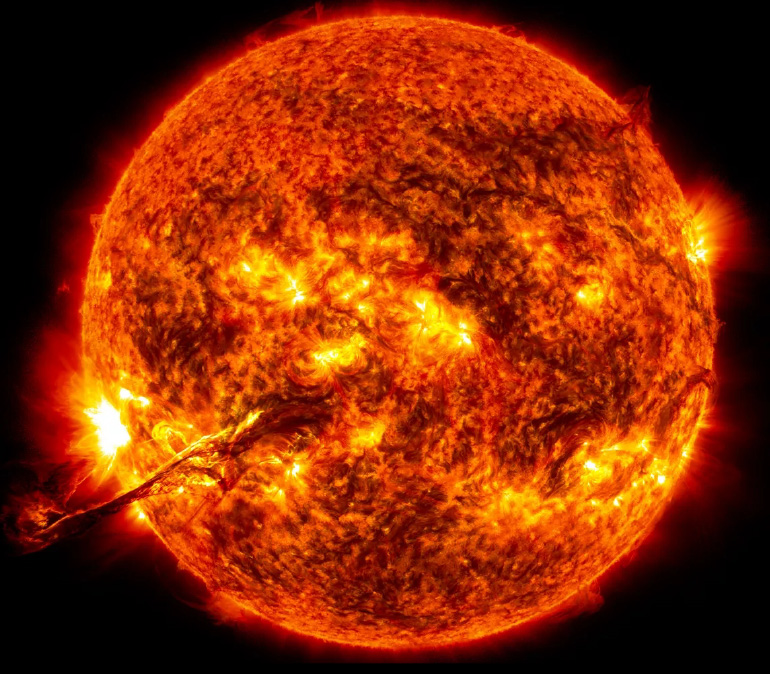

Sun
Soccer Stadium

Time

Definition: the accurate measurement of repeating patterns

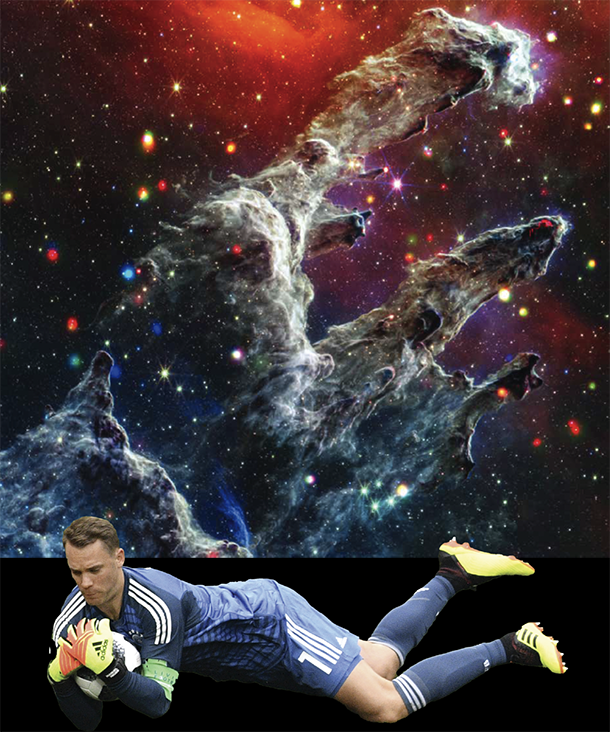
In soccer, time can come down to fractions of a second. A goalkeeper can react to a shot moving 190 km/hr in 0.03 seconds.

In space, time operates in dramatic ways. Sunlight reaches Earth in about 8 minutes, light from distant galaxies travels for billions of years, and powerful X-ray bursts from neutron stars can happen in milliseconds.

Units: seconds, years

COSMIC EXAMPLE

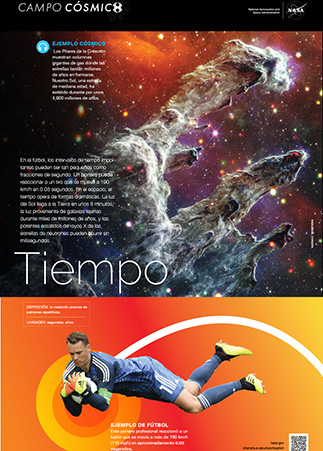
The Pillars of Creation show giant columns of gas where stars take millions of years to form. Our middle-aged Sun has existed for about 4.6 billion years.

SOCCER EXAMPLE

This professional goalkeeper reacted to a ball moving at over 118 mph (190 kph in about 0.03 seconds.)

Goal keeper

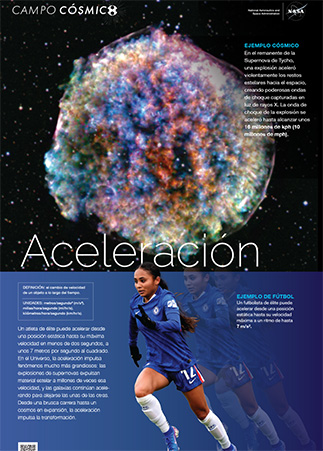
Acceleration

Definition: the change of velocity of an object over time.

A top athlete can accelerate from standing still to full sprint in less than two seconds — about 7 meters per second squared. In the Universe, acceleration drives far grander feats: supernovae blast material outward at millions of times that rate, and galaxies continue to accelerate away from one another. From a sudden dash to an expanding cosmos, acceleration powers transformation.

Units: meters/seconds2 (m/s2), miles/hour/second (mi/hr/s), kilometers/hour/second (km/hr/s)

COSMIC EXAMPLE

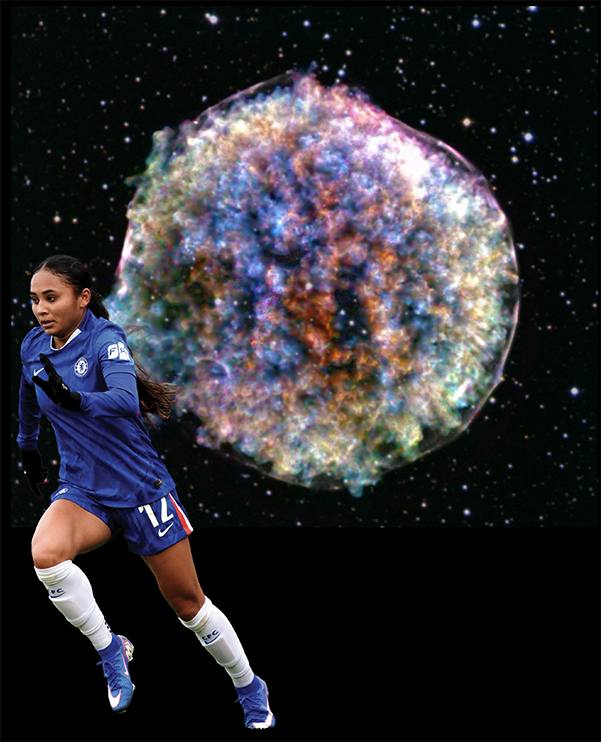
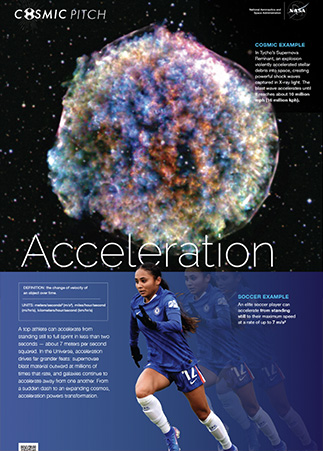
In Tycho’s Supernova Remnant, an explosion violently accelerated stellar debris into space, creating powerful shock waves captured in X-ray light. The blast wave accelerates until it reaches about 10 million mph (16 million kph).

SOCCER EXAMPLE

An elite soccer player can accelerate from standing still to their maximum speed at a rate of up to 7 m/s2

Soccer Player

Speed

Definition: distance traveled over a certain period of time

A ball struck by some of the world’s best players can reach speeds up to those of a car driving down a highway! In space, things move far faster — jets from black holes can shoot particles at nearly the speed of light, and entire galaxies are speeding away as the Universe expands. Whether chasing a goal or traversing galaxies, speed is the heartbeat of motion in both sport and space.

Units: miles per hour (mph), kilometers per hour (kph)

COSMIC EXAMPLE

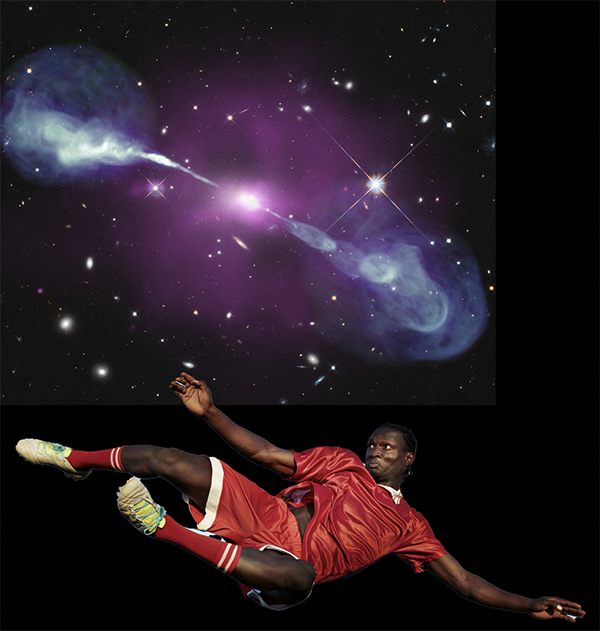
Hercules A is an active galaxy where a supermassive black hole powers enormous jets of particles, heating vast clouds of X-ray-emitting gas and moving at hundreds of millions of kilometers per hour.

SOCCER EXAMPLE

A perfectly struck soccer ball can reach over 100 mph (160 kph.)

Soccer Player

Collisions

Definition: When two or more moving objects come into contact and exchange forces with each for a brief period of time.

On the pitch, collisions between players happen all the time. How much energy do these collisions generate? There is a relatively simple way to calculate this based on the size (mass) of the players and how fast they are moving. In space, we can do the same thing. Of course, when we shift from the soccer field to outer space, the stakes of these collisions get much, much bigger.

Units: Watts or Joules

COSMIC EXAMPLE

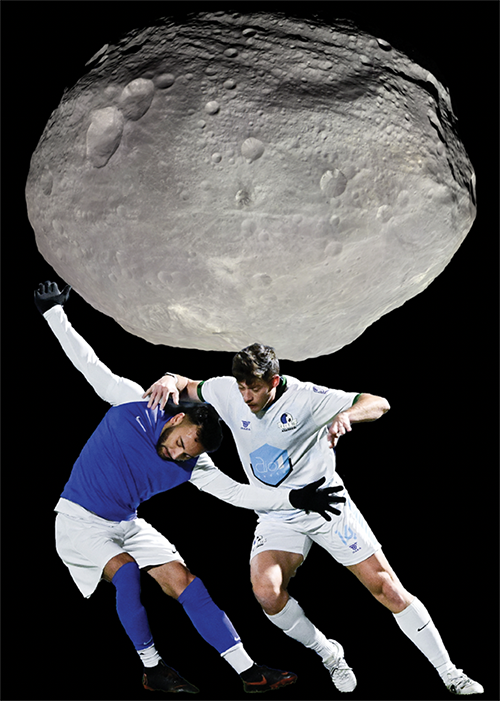
The asteroid named Vesta bears evidence of ancient high-speed collisions. If an asteroid about 6 miles (10 kilometers) across struck the Earth, it could generate about 2x10²³ (200 billion trillion) watts of energy.

SOCCER EXAMPLE

A collision lasting about 0.1 seconds between two players of about 175 lbs (80 kg) and 220 lbs (100 kg) moving at top speeds will generate over 70,000 watts of power.

Two Players

Kicks

Definition: distance traveled over a certain period of time

A ball struck by some of the world’s best players can reach speeds up to those of a car driving down a highway! In space, things move far faster — jets from black holes can shoot particles at nearly the speed of light, and entire galaxies are speeding away as the Universe expands. Whether chasing a goal or traversing galaxies, speed is the heartbeat of motion in both sport and space.

Units: miles per hour (mph), kilometers per hour (kph)

COSMIC EXAMPLE

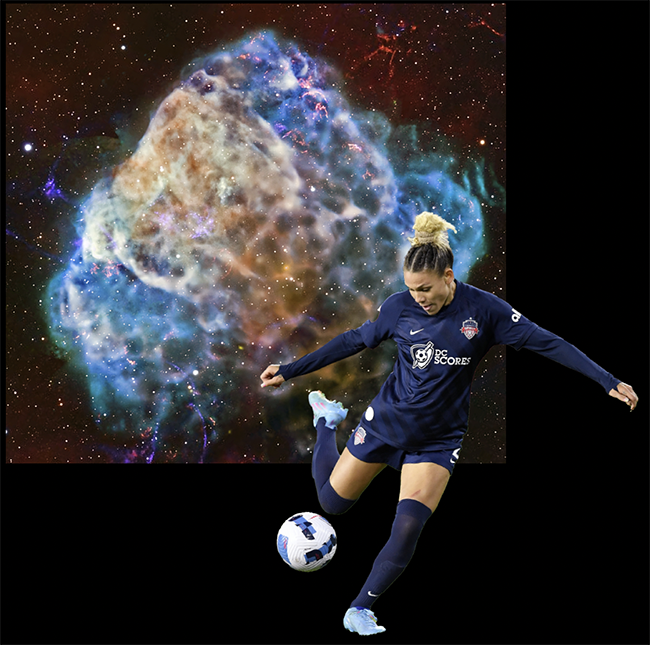
In supernova remnant Puppis A, a neutron star is racing away from its exploded parent star - strong evidence that uneven stellar collapse can blast these ultra-dense objects through space like cosmic cannonballs.

Initial velocity of neutron star kicked: 500,000 m/s 500 km/s

SOCCER EXAMPLE

A ball can travel at over 100 mph (160 kph) when it is first kicked by a player’s foot.

Soccor Player

Spin

Definition: when an object turns around a central axis. Rotational speed is defined as the number of turns around an axis over a given time.

When players curve the ball with spin, air pressure differences make it bend through its flight — a beautiful display of physics. In the cosmos, spin drives entire worlds: planets rotate, stars whirl, and neutron stars can spin hundreds of times per second.

Units: revolutions per minute (RPM), one cycle per second (Hertz)

COSMIC EXAMPLE

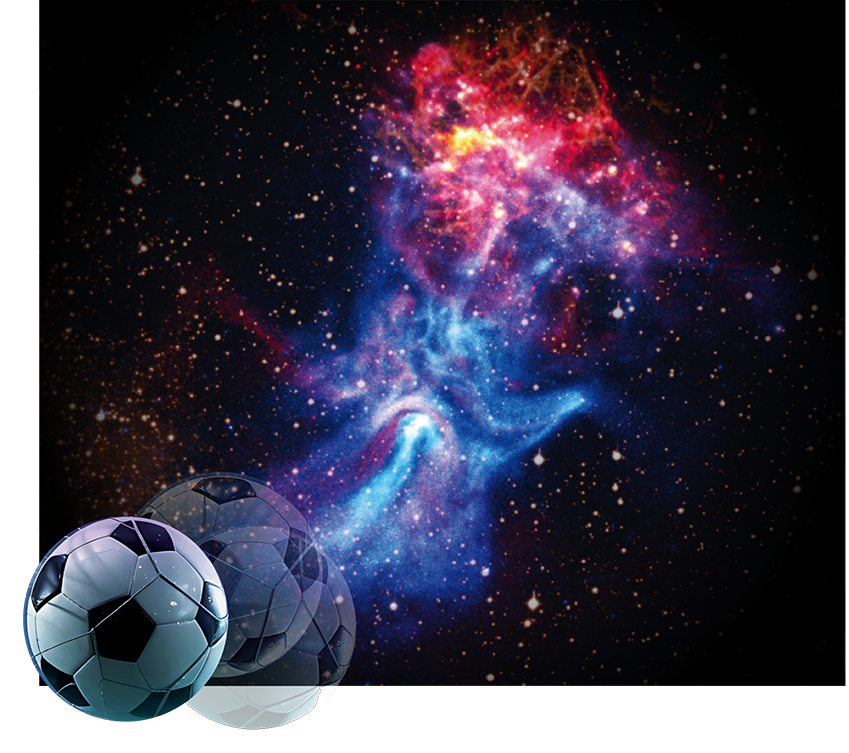
MSH 15-52 is powered by a pulsar that is spinning about seven times every second. This rotation drives energetic particles outward and creates the hand-shaped nebula seen in X-rays.

SOCCER EXAMPLE

Professional soccer players can make the ball spin 8-12 revolutions per second (720 RPM).

Soccor ball

Multiwavelength Playbook
To understand the physics of the Universe, NASA scientists look beyond what the human eye can see. Just as a coach uses different camera angles and data to track a player’s performance, astronomers use a fleet of “Great Observatories” and beyond to capture the Universe in different types of light.

High-energy X-ray data from NASA’s Chandra X-ray Observatory, as well as ESA’s XMM-Newton, reveal the extreme physics of the cosmos—such as the 10-million-mph blast waves of supernova remnants or the frantic spin of pulsars. By combining these X-ray action shots with infrared views from the James Webb Space Telescope, and Spitzer Space Telescope, and the visible light clarity of the Hubble Space Telescope along with ground-based optical telescopes, we get a more complete picture of cosmic motion.

This project also utilizes data from the Solar Dynamics Observatory (SDO) to study our Sun, the Dawn mission to explore asteroids, and ground-based radio telescopes from the NSF to track high-speed galactic jets. Whether it is on the pitch or in a distant galaxy, the laws of physics are the ultimate playbook.

Featured Missions: