
Normal Stars & Star Clusters
White Dwarf May Have Shredded Passing Planet

The destruction of a planet may sound like the stuff of science fiction, but a team of astronomers has found evidence that this may have happened in an ancient cluster of stars at the edge of the Milky Way galaxy.
Using several telescopes, including NASA's Chandra X-ray Observatory, researchers have found evidence that a white dwarf star - the dense core of a star like the Sun that has run out of nuclear fuel - may have ripped apart a planet as it came too close.
Our Universe in Color
Today we released six new images from Chandra’s vast data archive. Each one of these astronomical images combines X-rays from Chandra with data from telescopes that detect different types of light such as infrared, radio, and visible light.
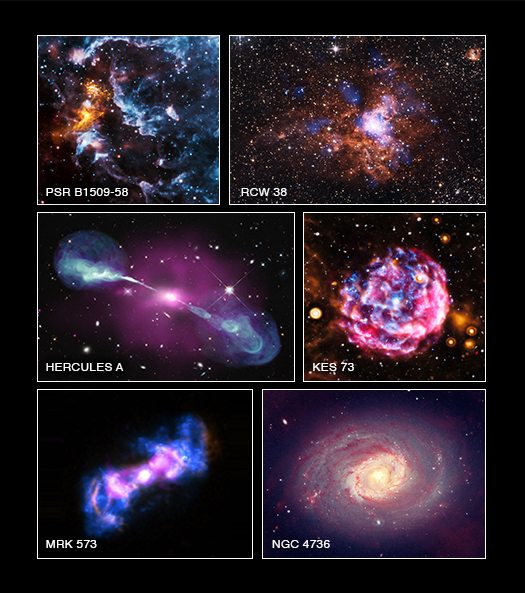
Chandra's Archives Come to Life
Every year, NASA's Chandra X-ray Observatory looks at hundreds of objects throughout space to help expand our understanding of the Universe. Ultimately, these data are stored in the Chandra Data Archive, an electronic repository that provides access to these unique X-ray findings for anyone who would like to explore them. With the passing of Chandra's 15th anniversary in operation on August 26, 1999, the archive continues to grow as each successive year adds to the enormous and invaluable dataset.
How a Planet Can Mess Up a Star's Looks
Note: An earlier version of this article appeared on Peter Edmonds' blog.
Recently, beautiful photos of auroras have been in the news. These colorful light shows were generated by solar storms, and provide a vivid demonstration of activity on the Sun affecting the Earth. The pummeling experienced by our home planet is an example of our one-way relationship with the Sun: it can have a noticeable effect on the Earth, but the Earth has a negligible effect on the Sun. Further afield in the galaxy, this isn't always the case. In a few other systems planets can have a big effect on their star, changing their looks in surprising ways.

A spectacular picture of auroras by photographer Mike Taylor taken over Unity Pond in Waldo County, Maine on September 12, 2014. Credit: Mike Taylor photography.
NASA's Chandra X-ray Observatory Finds Planet That Makes Star Act Deceptively Old

A new study using data from NASA's Chandra X-ray Observatory has shown that a planet is making the star that it orbits act much older than it actually is, as explained in our latest press release. The artist's illustration featured in the main part of this graphic depicts the star, WASP-18, and its planet, WASP-18b.
Our Neighboring Superstars

The Eta Carinae star system does not lack for superlatives. Not only does it contain one of the biggest and brightest stars in our galaxy, weighing at least 90 times the mass of the Sun, it is also extremely volatile and is expected to have at least one supernova explosion in the future.
Core-Halo Age Gradients in Young Stellar Clusters
We are delighted to welcome a trio of guest bloggers to discuss their work related to the newest Chandra press release on star clusters and star formation. Konstantin Getman, Eric Feigelson, and Michael Kuhn are colleagues at Penn State University and are all involved in the Massive Young Star-Forming Complex Study in Infrared and X-ray (MYStIX) project led from that institution.

Figure 1: From left to right, Michael Kuhn, Eric Feigelson, and Konstantin Getman.
NASA's Chandra Delivers New Insight into Formation of Star Clusters

Stars are often born in clusters, in giant clouds of gas and dust. Astronomers have studied two star clusters using NASA's Chandra X-ray Observatory and infrared telescopes and the results show that the simplest ideas for the birth of these clusters cannot work, as described in our latest press release.
Hardy Star Survives Supernova Blast

When a massive star runs out fuel, it collapses and explodes as a supernova. Although these explosions are extremely powerful, it is possible for a companion star to endure the blast. A team of astronomers using NASA's Chandra X-ray Observatory and other telescopes has found evidence for one of these survivors.
X-Ray Whispers In A Noisy Pub
We are delighted to welcome Katja Poppenhaeger as a guest blogger today. Katja is the first author of a new paper describing the first exoplanet transit ever seen in X-rays, the subject of our latest press release. Katja studied physics at Frankfurt University in Germany, followed by a PhD in astrophysics at Hamburg Observatory in Germany, before coming to Harvard-Smithsonian Center for Astrophysics (CfA) as a postdoc.